
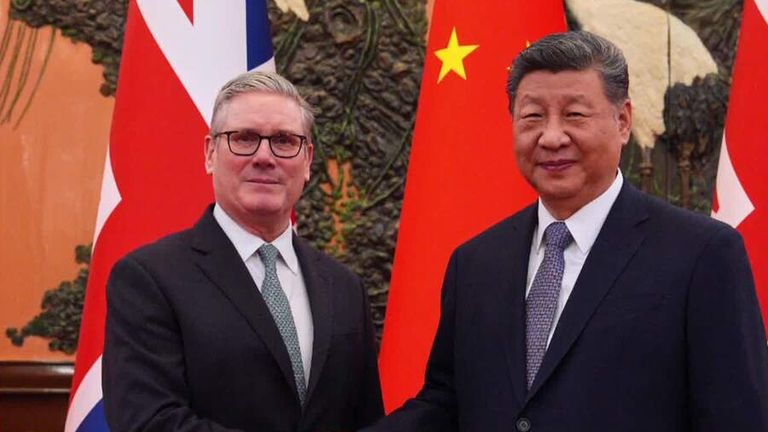
The trip marks the first visit by a British prime minister to China since 2018, when Theresa May met President Xi Jinping. Starmer’s government has described the visit as a practical effort to re-engage Beijing at a time of mounting global economic and security uncertainty.
A diplomatic reset in Beijing and Shanghai
Starmer met Xi and Chinese Premier Li Qiang in Beijing on Thursday before travelling on to Shanghai, where he is scheduled to hold talks with senior figures from both British and Chinese business communities.
Following their talks, both sides expressed support for developing a “comprehensive strategic partnership”, emphasising dialogue and cooperation despite ongoing disagreements.
Xi said relations between the two countries had suffered in recent years and argued that closer engagement was necessary to promote global stability. Starmer, in turn, said the UK and China should work together on shared challenges such as climate change and international security.
The prime minister is accompanied by a delegation of nearly 60 representatives from business and cultural sectors, including HSBC, GSK, Jaguar Land Rover, and the UK’s National Theatre.
Ahead of the visit, Starmer said the trip would open “significant opportunities” for British firms seeking to expand in China.
Why London wants closer engagement with Beijing
Starmer has framed the visit as a realistic assessment of China’s global importance, even as concerns persist in the UK over human rights and national security.
“Whether we like it or not, China is a major global actor,” he said before departing for Beijing, adding that engagement does not mean ignoring disagreements.
China has consistently rejected accusations of human rights abuses, calling them politically motivated.
Analysts say any meaningful economic revival in bilateral ties would depend on improved market access and regulatory clarity for UK companies. Jing Gu of the Institute of Development Studies noted that a stable framework with clear limits would be essential for rebuilding trust.
The economic context is pressing. Britain’s economy continues to feel the effects of Brexit, with research from the US-based National Bureau of Economic Research estimating a long-term GDP reduction of up to 8 percent. Investment and employment have also declined since the UK left the European Union.
Although the UK economy is forecast to grow modestly in 2026, it faces new headwinds linked to trade tensions driven by US President Donald Trump, whose administration has imposed tariffs on allies and adversaries alike.
Starmer’s visit follows similar China trips by leaders from France, Australia, South Korea, Finland and Canada, reflecting a broader effort among US-aligned countries to diversify economic partnerships.
What damaged UK-China relations?
Relations between London and Beijing deteriorated sharply after large-scale pro-democracy protests in Hong Kong in 2019. The UK criticised China’s subsequent security legislation in the territory, which criminalised a wide range of political activities.
In response, Britain introduced a special immigration route for eligible Hong Kong residents and has continued to condemn high-profile national security trials, including the prosecution of British citizen Jimmy Lai.
Further strain has come from allegations of Chinese espionage in the UK and Beijing’s political alignment with Russia during the war in Ukraine.
According to Steve Tsang of the SOAS China Institute, major concessions from China on sensitive political issues were unlikely during Starmer’s visit, despite Beijing’s interest in presenting the trip as diplomatically successful.
Security cooperation despite tensions
Security concerns remain a major point of friction. The head of MI5 recently warned that Chinese state-linked actors pose a persistent threat to UK national security.
Nevertheless, Starmer’s government has approved plans for China to open a large new embassy in London — a move criticised by opposition figures who fear it could be used for intelligence operations.
The visit also coincides with controversy surrounding the collapse of a UK espionage case involving two British men accused of spying for China. Prosecutors dropped the charges at the last minute, fuelling public debate.
China has denied all spying allegations, describing them as baseless.
Despite these disputes, Starmer’s trip highlighted areas of possible security collaboration. Downing Street said the UK and China agreed to cooperate on tackling the flow of synthetic drugs into Britain and disrupting supply chains for small boat engines used by people-smuggling networks crossing the English Channel.
The agreement is expected to involve intelligence sharing and direct engagement with Chinese manufacturers to prevent criminal misuse of legitimate exports.
Sarah Mitchell is a correspondent for The Washington Award.